
Business rates: Occupying, leaving or vacating a property
Business rates and types of premises
Types of property that must pay business rates and those that are excluded.
Business or non-domestic premises include most commercial properties, such as shops, offices, pubs, warehouses, and factories.
Properties excluded from the valuation list for business rates
There are some types of properties that are specifically excluded from the valuation list and therefore not subject to rates:
- fish farms
- most farmland and farm buildings
- most cemeteries and crematoriums
- turbary and fishing rights
- moveable moorings
- public parks
- sewers
Properties exempt or partially exempt from business rates
Some non-domestic premises that are exempt or partially exempt from rates include:
- places of public religious worship and church halls
- district council swimming pools and recreation facilities
- charity shops selling only donated goods
- ATMs in designated rural wards
Mixed-use properties and business rates
If part of a building is used for business and part for residential purposes - such as a shop with a flat above or a solicitor's office in a domestic property - the part used for business counts as non-domestic premises. So, if you live and work on the same premises, you generally pay business rates on the part of the property used for business and domestic rates on the residential part.
Rental properties and business rates
Special rules apply to landlords, owners, and tenants depending on the level of Capital Value for domestic properties or Net Annual Value for non-domestic properties. Rental properties and business rates.
Working from home and business rates
If you use your home as a workplace, the part of the property used for work may be liable for business rates. You will still have to pay domestic rates on the rest of the property. Whether you are charged business rates or not depends on the degree of business use. You are more likely to have to pay business rates if a room is used exclusively for business or has been modified, eg, as a workshop. Each case is considered individually.
Further information
If you have a query regarding your business rates, contact Land & Property Services.
Developed withAlso on this siteContent category
Source URL
/content/business-rates-and-types-premises
Links
How business rates are calculated
How rates are calculated for business premises and how to get an idea of what your rate bill may be.
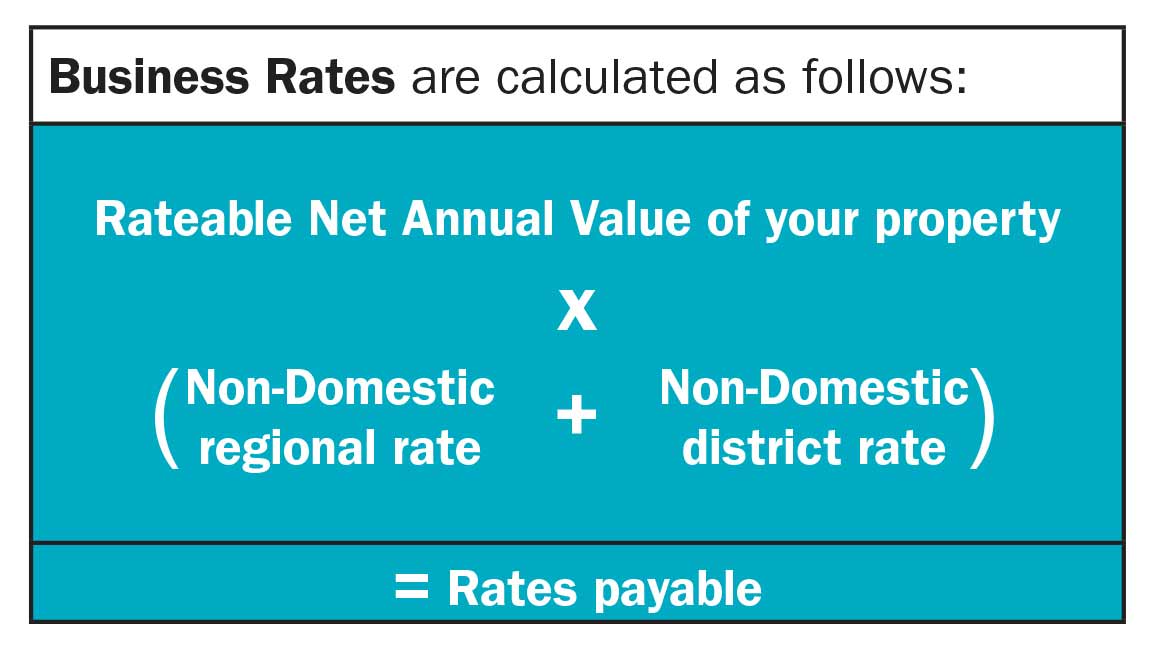
Your rate bill is made up of a number of parts including the regional rate, the district rate and Net Annual Value (NAV). Your rate bill is calculated by multiplying the NAV of your property by the non-domestic rate poundage (non-domestic regional rate + non-domestic district rate) for your council area for the relevant year (as shown below):
Regional and district rates
The regional rate is set annually by the Northern Ireland Executive and is applied to each district council area in Northern Ireland. The district rate is set annually by each district council in Northern Ireland.
Find the the 2026-27 non-domestic rate poundages for your council area.
Net Annual Value
Rates for non-domestic or business properties are assessed on their rental value, also known as the Net Annual Value (NAV). NAV is an assessment of the annual rental value that your property could reasonably be expected to be let for if it was on the open market. Each non-domestic property is valued in line with comparable properties in the vicinity.
The current valuation list for non-domestic properties began on 1 April 2023 and is based on rental values as at 1 October 2021.
Find a property valuation for your business premises.
View your estimated rate bill
You can view an estimate of a full annual rate bill for the current rating year by inputting the address information using the Land & Property Services (LPS) online valuation search.
Find a property valuation and view your estimated rate bill.
Further information
If you have a query regarding business rates or are unsure of your outstanding bill, contact LPS.
NI Reval2026
The short video below explains the latest revaluation process, known as NI Reval2026, which will create a new valuation list that will be used to calculate business rate bills from April 2026.
Developed withAlso on this siteContent category
Source URL
/content/how-business-rates-are-calculated
Links
Rates for retail units
How business rates are calculated for retail units and how this differs from other types of non-domestic properties.
When calculating business rates for retail units Land & Property Services (LPS) assess the Net Annual Value (NAV) by using zoning. Zoning is a methodology used in assessing the rental value of retail units and is used for shops, hair salons, banks, betting shops and most restaurants. LPS use zoning as it helps take into account different sizes and shapes of shops and awkward layouts.
LPS also consider other parts of the property that are ancillary or tertiary spaces such as upstairs offices and store rooms. They are rated but zoning is not applied for these areas of the property. Some spaces are not considered useable retail areas and are excluded from valuation. These spaces include toilets, lobbies, plant rooms and stairwells.
Further information
If you have a query regarding business rates, contact LPS.
NI Reval2026
On Thursday 29 January 2026, the Finance Minister John O'Dowd announced a pause of the Reval 2026 process. This page will be updated when the next steps are confirmed.
The short video below explains the latest revaluation process, known as NI Reval2026, which will create a new valuation list that will be used to calculate business rate bills from April 2026.
Developed withAlso on this siteContent category
Source URL
/content/rates-retail-units
Links
Rates for licensed premises
How business rates are calculated for licensed premises and how this differs from other types of non-domestic properties.
When calculating business rates for licensed premises, Land & Property Services (LPS) assess the Net Annual Value (NAV) by calculating the correct level of Fair Maintainable Trade (FMT). LPS does this by collecting information about rent, trading receipts, and trading patterns. LPS analyses this information along with the type of premises, the area it is in, and what services it offers.
As there is little evidence of rents for pubs, LPS uses FMT in the assessment to help assess a rateable value or NAV. This is the industry standard and is the approach used across the UK.
LPS applies a percentage to the estimated FMT to assess the annual rent. It is based on factors such as, where the premises are located, the sort of premises they are (bar, hotel, etc.), and the sort of trade carried on. LPS regularly consults with trade associations to ensure its approach continues to reflect how the licensed industry operates.
Further information
If you have a query regarding business rates, contact LPS.
NI Reval2026
On Thursday 29 January 2026, the Finance Minister John O'Dowd announced a pause of the Reval 2026 process. This page will be updated when the next steps are confirmed.
The short video below explains the latest revaluation process, known as NI Reval2026, which will create a new valuation list that will be used to calculate business rate bills from April 2026.
Developed withAlso on this siteContent category
Source URL
/content/rates-licensed-premises
Links
Business rates: Occupying, leaving or vacating a property
How your business rates are affected if you occupy, leave, or vacate a property and how to inform Land and Property Services of changes.
Moving into a new business property
When you move into your new property, you must contact Land & Property Services (LPS) Rating office to let them know, otherwise you may receive a backdated rate bill. You can also advise them of how you wish to pay your rate bill.
Moving into a newly built business property
If you are moving into newly built premises, you must contact the LPS Valuation office. A valuer will come out to assess your property. A rate bill will then be issued based on this valuation. You should be aware that failure to inform LPS could lead to the issue of a backdated rate bill.
You can apply online to have your new property valuation assessed, or you can apply for a new property valuation or review of property valuation.
This is a writable document, which means that you can complete it on screen and send it as an attachment by email to print and send to the LPS Valuation office. You can also print and post it to LPS using the address on the form.
Leaving your old business property
When you move out of your property, you must contact LPS. You should have your Account ID, Ratepayer ID, and details of the new owners or people in your property to hand.
Alternatively, you can use the online form to make changes to your rate account, such as personal information, billing address for your rate bill, notification of a ratepayer's death, or change the assessment period for your rate account.
You can also make changes to your rate account through your Rates Online account.
Further information
If you have a query regarding business rates, contact LPS.
Developed withAlso on this siteContent category
Source URL
/content/business-rates-occupying-leaving-or-vacating-property
Links
How Land & Property Services uses your information
How LPS uses customer data and how they protect this data under the legislation.
Land & Property Services (LPS) fully complies with the Data Protection Act 2018 and the Department of Finance's Data Protection Policy. This means that how LPS collects, stores, uses, and discloses/shares the information you provide to them meets the standards of this legislation.
Reasons why LPS collates and holds customer information
LPS holds customer information for:
- the purpose of billing
- collection and recovery of rate revenue
- assessment of benefit/relief claims
- the creation and maintenance of Valuation Lists
- the Land Registration Public Register
LPS and the National Fraud Initiative
LPS has a duty to protect public funds and may use the information provided for the prevention and detection of fraud.
LPS participates in the National Fraud Initiative, an exercise that matches electronic data within and between audited bodies to prevent and detect fraud.
The use of data by the Audit Commission does not require the consent of the individuals concerned under the Data Protection Act 2018. However, it is controlled to ensure compliance with data protection and human rights legislation.
For more information, contact LPS.
Developed withAlso on this siteContent category
Source URL
/content/how-land-property-services-uses-your-information
Links