
Should I rent or buy business property? (video)
In this guide:
- Renting commercial property
- Should I rent or buy business property? (video)
- Advantages of renting commercial property
- Find commercial property to rent
- Commercial property rental agreements
- Renting commercial property: practicalities
- Costs when renting commercial property
- Alterations to rental properties
Should I rent or buy business property? (video)
Short video will help you decide whether renting or buying premises is best for your business needs.
This short video (5 minutes, 48 seconds) will help you identify whether you should rent or buy business property.
Also on this siteContent category
Source URL
/content/should-i-rent-or-buy-business-property-video
Links
Advantages of renting commercial property
The business benefits of renting property can range from better cashflow to having more flexibility if you need to relocate your business in the future.
Buying business property is a big commitment and it's important to consider carefully whether renting property may be a better option for your business.
Flexibility of renting business property
Renting business premises can provide more flexibility for your business as it grows. You are not locked into property ownership and you can usually agree with your landlord on the length of the rental lease that you require, or have a break clause included in the lease. This will let you end the rental lease (usually on a specific date) if, for instance, you want to relocate. See business tenant's rights to end a tenancy.
Renting a business property can also give you space for negotiation with the landlord. You or your agent can negotiate any aspect of the rental lease, either at the start or if you want to renew it after the rental lease ends.
Financial benefits of renting business property
From a financial perspective, renting property can make good business sense. Upfront costs for leasing premises are often relatively low, though you may pay a premium to purchase the lease. Sometimes you may also have to provide a refundable deposit. But generally renting ties up less capital than buying business property, freeing up cash that could be used elsewhere in the business. See renting business property: practicalities.
If you rent your business property you are not exposed to interest rate rises, although your rent may rise periodically as a result of rent reviews. Always check to see how rent is reviewed before you sign the rental lease. See business leases: paying rent and rent reviews.
There is also less potential for unexpected economic fluctuations such as a decrease in property value - unless you wish to sell the remaining term on your rental lease to someone else. Also, you will not have to pay Capital Gains Tax unless you decide to sell your rental lease for a premium.
Maintenance responsibility in rented business property
You may have less responsibility for the building if you rent rather than buy a business property, although this will depend on the terms of your rental lease. As a tenant you may have responsibility for repairs and maintenance inside the building but external maintenance is more likely to be the responsibility of the landlord, particularly in multi-occupancy premises. Be mindful that you may have to pay a service charge as part of your rental agreement. See commercial property: landlord and tenant responsibilities.
Also on this siteContent category
Source URL
/content/advantages-renting-commercial-property
Links
Find commercial property to rent
Your options to find suitable business premises to rent including how to use a commercial agent to search for you.
There are a number of ways to search for appropriate business property to rent.
How to find a business property to rent
To begin your search for business property to rent you could consider:
- using our commercial property finder tool
- visiting a local estate agent in person
- searching estate agent websites
- touring your local area to see agents' letting boards outside the business property for let
- property listings in local newspapers
- your local council - through their Economic Development Unit
- trade associations - if an existing member is retiring or selling up their business
Commercial agents
Another good way to find a suitable business property to rent is by appointing a commercial agent or commercial surveyor to search on your behalf. You can find a commercial surveyor near you.
Commercial agents and surveyors have expertise in the business property market in the area and can keep you up to date with any new commercial property that comes onto the market for rent. They will also send you detailed specifications of a suitable property, which can be very useful, particularly if you are limited by time.
You must pay a commission to a commercial agent for acting as an intermediary between you and the landlord or seller. You will need to fully brief the agent, manage the relationship well and maintain regular contact to ensure that they find you the most suitable property.
When employing an agent to act on your behalf, you should also draw up a contract, even if the relationship is informal. This will help to set out expectations and clarify your legal obligations to them from the start. See sell through a commercial agent.
Also on this siteContent category
Source URL
/content/find-commercial-property-rent
Links
Commercial property rental agreements
An overview of the types of property rental agreements available to businesses looking to rent premises.
You can rent business property by leasing it. If you require premises for a short term, for example, to complete an unusually large order, then consider a licence rather than a lease.
Leasing business premises
Leases typically have agreements of between three and 25 years and can offer long-term stability for your business.
You will probably be able to negotiate the length of your rental lease with your landlord and should certainly check before signing the contract. You should also seek legal advice - see choose a solicitor for your business.
Other than the rent itself, key areas of the contract that you should study include:
- lease length
- break clauses
- service charges
- dilapidations (an amount payable to the landlord at the end of the lease)
- responsibility for maintenance and repairs to the building and external areas
Lease length
Rent is usually paid quarterly in advance. However, you may be able to pay monthly. This can form part of negotiations with your landlord. If your business is new, you may want to consider a short lease of three years or less. You may also want to ask for a break clause.
Service charges in rental properties
Check how much service charges are and which services they specifically cover, such as cleaning and heating. Establish what facilities you may be sharing with other tenants. Service charges are an additional cost to the rent and can be more expensive than if you organise them yourself.
You have the right to ask the landlord for a summary of how the service charge is calculated and for any paperwork supporting the summary eg receipts. Your landlord must provide this information as it is a criminal offence not to. See service charges in commercial property.
You have the right to remain in occupation of the premises and renew the lease once it expires unless you and your landlord have agreed otherwise. However, there are specific cases when the landlord can refuse to grant a renewal. See business leases: renewing and ending.
Licensing business premises
A licence could be of benefit to a small business looking for a short-term property rental solution, of up to one year. Licences generally offer more flexibility and can usually be terminated at short notice on both sides. However, you would not have an automatic right to renew a licence and it is always advisable to seek professional advice, eg from a chartered surveyor or solicitor before pursuing it.
Also on this siteContent category
Source URL
/content/commercial-property-rental-agreements
Links
Renting commercial property: practicalities
The costs, considerations and obligations of renting business property.
There are a number of practical issues to consider when you rent a business property.
Rental property contracts
Contracts when renting business premises can be complex, so consider professional help from a solicitor or chartered surveyor. While this can be expensive, mistakes can be much more costly to remedy.
You can find a surveyor in your area or find details of local solicitors.
Planning permission for rental properties
Before renting business premises, make sure you have planning permission to make any changes you need to the property. See alterations to rental properties. You should also investigate whether the building has asbestos.
Find out if there are any restrictions on delivery or loading times that may affect your business. There may be other restrictions or covenants in the lease or imposed by the local council - for example, rubbish disposal, parking, noise, lighting, and litter. Find your local council in Northern Ireland.
Land registration
The Department of Finance provides guidance on how to register land in Northern Ireland, and the associated fees.
Insurance for rental properties
The business lease will state whether you or the landlord need to arrange insurance for the property. If the landlord arranges this, you will pay the premiums as part of the service charges. Therefore, you may need to take out additional insurance to cover risks, such as loss or damage to contents, which are not covered in the building policy. See insurance: business property and assets.
Also on this siteContent category
Source URL
/content/renting-commercial-property-practicalities
Links
Costs when renting commercial property
Financial commitments when renting business premises, including rent, bills and taxes.
Your financial commitments when renting business property can include:
- a premium to purchase the lease
- rental costs
- service charges
- utility bills
- maintenance and repair bills
- a deposit - typically equivalent to three or six months' rent
- stamp duty, which is payable on all commercial leases
- business rates - estimate your rate bill
Normally, the landlord will request references to confirm you are able to pay your rent and meet your rates liability. You may find it helpful to have a guarantor for your rent and other liabilities under the lease.
Energy costs for rental properties
All landlords of commercial buildings must provide prospective tenants with an Energy Performance Certificate (EPC). An EPC indicates how energy efficient a building and its services are and can act as a gauge of likely energy costs. See Energy Performance Certificates for business properties.
Air conditioning and heating systems can have a significant effect on your overall energy bills. You can make substantial savings by keeping these well-maintained and having them inspected often by a qualified engineer. See use heating and hot water systems efficiently.
ActionsAlso on this siteContent category
Source URL
/content/costs-when-renting-commercial-property
Links
Alterations to rental properties
Issues to consider before you alter your rented business premises, such as planning permission, asbestos, and liability.
There are a number of issues to consider before you alter the business premises that you are renting.
Planning permission
Planning permission is not always required if you wish to make alterations to the property, for example, if you want to make changes to the inside of the building or minor alterations to the outside. Also, a specific application is not needed if you want to put up low walls or fences, although you should always check whether building regulations are required by contacting the building control section at your local council.
However, planning permission is generally required if you want to extend, convert or change the external nature of the premises. It is always a good idea to check with your local planning authority whether the development will require planning permission at the proposal stage. The majority of significant building work also has to conform to building regulations. Planning permission.
Landlord's permission
Before you start any alteration work, you should check the details of the rental lease. You may need to get permission from the landlord. Unless the lease expressly prohibits improvements, the landlord may not unreasonably withhold consent to tenants' improvements. Also, you should clarify whether you will be required to reinstate the property to its original condition before the agreement expires.
Energy Performance Certificate
If you change the number of units that the property is divided into (for example dividing one shop unit into two or merging two into one), which include fixed services for heating, hot water, air conditioning, or mechanical ventilation, an Energy Performance Certificate will be required when the work is completed. It is the responsibility of the person carrying out the building work to provide the certificate.
Asbestos
Before any alterations are made you should consider whether asbestos might be present within the property.
Rateable value
You should also check whether the works you are planning will alter your rateable value. The rateable value of business premises is based on their open market rental value. Changing your premises may affect this. See property changes and business rates.
Repairs to rental properties
You also need to be aware of the liability for repairs. If you rent workspace in multi-occupancy premises, liability for external repairs and maintaining common areas is likely to fall with the landlord. Check the terms of the lease to find out who is responsible.
You should also check the rental agreement to see whether there is any repair work pending. You may decide to commission a survey and ensure that any such work is finished before the rental agreement is signed in order to avoid paying the bill.
Also on this siteContent category
Source URL
/content/alterations-rental-properties
Links
Deciding on the right premises for your business (video)
In this guide:
- Choosing the right commercial property
- Business property specification
- Choose the right location for your business premises
- Legal considerations when choosing business property
- Deciding on the right premises for your business (video)
- Search for commercial property
- Six tips for choosing the right business property
- Choosing the right premises to suit our business needs - Totalmobile (video)
Business property specification
How to draw up a wish list that sets out what you want when searching for suitable commercial premises.
Preparing a clear business property specification is an important first step when choosing commercial property. A well-defined property spec helps you focus your search for commercial premises, compare options consistently, and avoid wasting time on unsuitable business property.
What is a property specification?
A business property specification, or property spec, is a written list of what you need from your commercial premises for business. It sets out your essential and desirable requirements. It guides your search for business premises to rent or buy, whether you are looking at larger sites or commercial properties for a small business.
Key points to include in your property spec
Your property spec might detail how the following requirements should be met when looking for suitable commercial real estate or business premises.
Property size and layout
Decide how much space you need now and, in the future, based on staff numbers, equipment and storage. Consider whether an open-plan layout, individual offices, or a mix of both will work best, and whether you need extra areas for equipment, storage, meetings, breakout spaces or socialising.
Property appearance
Think about how the business property looks both inside and out. If clients or customers will visit regularly, you may need a more visually attractive exterior and a professional, welcoming interior that reflects your brand and creates a good first impression.
Property structure
Identify any special structural requirements. For example, you may need high ceilings, upper-floor loading capacity, reinforced floors or foundations, or specific loading doors or access arrangements to support your operations.
Premises facilities
Consider the comfort and wellbeing of employees and visitors. Make a note of the standard of lighting, toilet and washrooms, reception or waiting areas, kitchen or tea points, and any staff welfare or breakout facilities you require.
Property utilities and connectivity
List the utilities and services you need for your commercial property to operate efficiently. This can include:
- adequate power supply and type (for example, three-phase electricity)
- heating and cooling systems to maintain comfortable working conditions
- sufficient power points for computers and equipment
- suitable water supply and drainage
- broadband speed and reliability, including fibre availability
Older buildings may need rewiring, upgraded heating or air conditioning, or additional toilet and kitchen facilities, so factor potential upgrade costs into your planning.
Planning permission and use
Check whether you may need planning permission or a change of use to run your type of business from the premises. Understanding this early can help you avoid delays or unexpected costs once you have chosen your commercial premises.
Access and parking
Think about how people and goods will reach your business property. Consider:
- proximity to main roads and public transport
- ease of access for deliveries and collections
- accessibility for customers, including disabled customers
- on-site or nearby car parking for staff, customers and visitors
- any need for cycle parking or other sustainable transport options
Option to extend or make alterations
Assess how flexible the commercial real estate is if your requirements change. Look at whether you can make internal alterations, install partitions, expand into neighbouring space, or extend the building in future, subject to any necessary consents.
Long-term business plans
Review your business plan and consider how the business premises you choose will support your long-term direction. Think about potential growth, new services or products, changes in staffing levels, or future technology needs, and whether the property can adapt to these.
Property location
Location is a crucial factor when choosing commercial property. You need to think about where your property should be to suit your customers, workforce and suppliers, as well as your brand image and operational needs. For detailed location factors you should consider, see choose the right location for your business premises. See, choose the right location for your business premises.
Property costs
Your choice of commercial property will also depend on your budget. Whether you rent or buy business premises, likely costs can include:
- initial purchase costs (if buying property), including legal costs and surveyor's fees
- initial alterations, fitting out and decoration
- any alterations required to meet building, health, safety and fire regulations
- ongoing rent (if leasing premises), service and utility charges, including water, electricity and gas
- business rates
- continuing maintenance and repairs
- building and contents insurance
It can be useful to compare the costs of buying business property with the costs of buying business property so you can decide which option is more suitable for your cash flow and growth plans.
Energy performance of the property
Energy efficiency affects both your running costs and environmental impact. Sellers and landlords must provide prospective buyers or tenants with an Energy Performance Certificate (EPC). An EPC shows how energy efficient a building and its services are and provides a good indication of likely energy costs. You may wish to prioritise commercial property for small businesses that offer better energy performance to help control long-term overheads. See Energy Performance Certificates for business properties.
Prioritising your requirements
If your property requirements are too specific, your choice of commercial premises for business may become very limited or too expensive. Divide your property spec into:
- essential requirements that you cannot compromise on
- desirable features that are beneficial but negotiable
This helps you stay flexible and make a balanced decision when comparing different commercial property options.
Considering working from home
Once you have drawn up your list of property requirements, you may decide that working from home suits your needs better, either full-time or as part of a hybrid model. If so, remember that there are important legal, tax and practical issues to consider, including planning, insurance and health and safety. See use your home as a workplace.
Also on this siteMore Case StudiesContent category
Source URL
/content/business-property-specification
Links
Choose the right location for your business premises
How to identify the advantages and disadvantages when choosing a suitable location for your commercial property.
Choosing the right location for your commercial property is a vital decision for any business. Your business premises should be convenient for customers, employees and suppliers, while still being affordable and aligned with your long term plans. When choosing commercial property, you should weigh up the advantages and disadvantages of different locations before committing to any business property.
What location factors should I consider when looking for business property?
To judge the best location for your commercial premises for business, consider the key factors below and how important each one is to your business priorities. These points apply whether you are looking for business premises to rent, business premises to buy, or specific commercial property for a small business.
Footfall
For many businesses – especially in the retail, hospitality or personal services sectors – the level of passing trade can have a major impact on sales and visibility. Busy high streets, shopping centres, or transport hubs can provide higher footfall but usually come with higher commercial real estate costs and business rates.
Competitors in the area
The number and type of competitors nearby can significantly affect your performance. Some businesses, such as estate agents or restaurants, can benefit from clustering together, as customers often compare options in one area. For many other firms, too many direct competitors close by can reduce your market share and profitability, so it is worth surveying the local area carefully before choosing your business property.
Transport links and parking
Good public transport links and local parking facilities make it easier for employees, customers and suppliers to reach your commercial property. Check proximity to bus routes, train stations, cycle paths and major roads, and consider whether there is sufficient, affordable parking nearby for staff and visitors.
Delivery restrictions
If your business relies on regular deliveries or collections, it is important that your commercial premises for business are easy for vehicles to access. Investigate any delivery time restrictions, loading bay rules, or weight limits that could affect your suppliers or logistics operations.
Planning restrictions
Before you commit to a location, make sure the premises can legally be used for your type of business. Check planning permission and local zoning or use classes to ensure your activity is permitted, and identify any restrictions that might limit how you operate or expand in future.
Business rates
Business rates can be a major ongoing cost and vary depending on property value and location. High-profile city or town centre locations can attract higher rates, which may reduce the attractiveness of otherwise ideal business premises to rent or buy. It is important to get an indication of what you may have to pay so you can factor it into your overall budget. See estimate your rate bill.
Local amenities
Local amenities can make a location more attractive for both employees and customers. Staff often prefer working in areas with nearby shops, cafés, childcare, gyms and other services. You may also need convenient access to banking facilities, postal depots and professional services to support day-to-day operations in your commercial property.
Type and image of an area
The nature and reputation of the area can affect how your business is perceived. A location associated with high crime or anti-social behaviour may deter customers and staff, while a well-regarded business district or regeneration area can enhance your image. Think about how the area aligns with your brand and the clients you want to attract when choosing commercial property.
Deciding on your property location
Every location will have both advantages and disadvantages, so finding the right business property is often a balancing act. For example, an office in a rural setting may be quieter and cheaper, but harder for staff, customers or suppliers to access. A prime city centre site may be excellent for visibility and transport links, but more expensive in terms of property costs, business rates and parking.
Location has a major impact on your overall business costs and on the value you get from your commercial real estate. If you need premises in a prime area – for example, to access key clients or benefit from strong footfall – the extra cost may be justified. The key is to prioritise the factors that matter most to your strategy and choose commercial property that offers the best overall fit for your business.
Also on this siteMore Case StudiesContent category
Source URL
/content/choose-right-location-your-business-premises
Links
Legal considerations when choosing business property
What legal obligations and restrictions to consider when choosing commercial premises.
When choosing commercial property, it is essential to understand the legal obligations and restrictions that apply to your business property. These rules affect both owners and occupiers and will influence the suitability of any commercial premises for business, whether you are looking for business premises to rent or business premises to buy.
Planning permission and permitted use
Your commercial property must have the correct planning permission or use class for your type of business. If you intend to change how the property is used, extend it, or alter its layout, you may need to apply for new planning consent or building control approval.
Failing to comply with planning requirements can lead to enforcement action, so always check permitted use before committing to any commercial property for a small business or larger operation.
Building, fire and health and safety compliance
All commercial property must meet relevant building regulations and fire safety standards. You will need to carry out suitable fire risk assessments, maintain fire detection and alarm systems where required, and ensure that escape routes, emergency lighting and fire-fighting equipment are appropriate for your business premises.
You must also comply with health and safety law to protect employees, contractors and visitors, including providing safe access, adequate ventilation, lighting, welfare facilities and a generally safe working environment. See fire safety and risk assessment.
Business rates, stamp duty and other charges
Most business premises to rent or buy will attract business rates, based on the property’s rateable value and local rules. In many cases, stamp duty land tax (or the relevant property tax) is payable on commercial property purchases and some leases, so factor this into your budget alongside rent or mortgage payments.
Clarify in advance whether the landlord or tenant is responsible for business rates, service charges and other recurring costs before you sign any agreement for commercial premises for business.
Landlord, tenant and lease obligations
If you occupy business premises to rent, the terms of your lease or licence will set out your rights and responsibilities. These may cover rent reviews, repairing obligations, service charges, use restrictions, alterations, subletting, break clauses and how and when the lease can be ended.
You should ensure that any lease for commercial real estate is clearly understood and, where possible, professionally reviewed so you know exactly what you are committing to over the term. See commercial property: landlord and tenant responsibilities.
Employer duties and workplace conditions
If you employ staff in your commercial property, you are responsible for their health, safety and welfare while at work. This includes providing suitable welfare facilities (such as toilets, washing facilities, drinking water and rest areas), a healthy indoor environment and safe systems of work.
You must identify and manage workplace risks, maintain equipment safely and ensure your business property is suitable for the number of people working there. See workplace welfare facilities and healthy working environment.
Accessibility and equality requirements
If you provide goods or services to the public, you must take reasonable steps to make your commercial premises for business accessible to disabled people. This may involve ramps or step-free access, appropriate signage, accessible toilets, suitable door widths or layout changes.
Considering accessibility early, when choosing commercial property, can save costs and reduce the risk of failing to meet equality and anti-discrimination duties. See disabled access and facilities in business premises.
Operating licences, restrictions and environmental controls
Certain types of business activity require licences or permits – for example, selling alcohol, handling specific waste types or operating some regulated services. There may also be conditions on when deliveries can take place, limits on noise levels, restrictions on emissions, and rules on waste storage and disposal. Before you choose business premises to buy or rent, check whether your activities will need additional permissions or be affected by local environmental or neighbourhood restrictions.
Insurance for business property and assets
Whatever commercial property you occupy, adequate insurance is essential. Common policies include buildings insurance (if you are responsible for the structure), contents and equipment insurance, public liability, employer’s liability and business interruption cover.
Check what the landlord insures, what you must insure yourself, and whether your chosen commercial property for a small business presents any special risks that need extra cover. See insurance: business property and assets.
Getting professional legal advice
Legal requirements around commercial real estate can be complex and may vary depending on location, sector and property type. Before signing a lease, purchase contract or licence, it is sensible to seek advice from a suitably qualified solicitor or business adviser experienced in commercial property. They can help you interpret legal documents, identify hidden risks and ensure the business property you choose is compliant and suitable for your plans. Choose a solicitor for your business.
More Case StudiesContent category
Source URL
/content/legal-considerations-when-choosing-business-property
Links
Deciding on the right premises for your business (video)
Short video outlines key factors to consider when deciding on suitable business premises.
View this short video (2 minutes 30 seconds) below that outlines important factors to consider when deciding on the right business premises. It explores issues such as cost, location, facilities, and infrastructure.
Also on this siteContent category
Source URL
/content/deciding-right-premises-your-business-video
Links
Search for commercial property
Specifying what you want when searching for business premises and where you can search for suitable commercial property.
Starting your search for commercial property by drawing up a clear business property specification is one of the most effective ways to find suitable commercial premises for business. A well-defined “property spec” sets out your essential and desirable requirements, helps you prioritise location and property features, and makes it easier to compare different business premises to rent or business premises to buy.
Define what you need before you search for a property
Begin by creating a written specification that clearly describes what you need from your business property. Include details such as size, layout, facilities, utilities, accessibility, budget range, and preferred locations, and highlight which points are non-negotiable and which are flexible. This will guide your decisions when choosing commercial property and reduce the time spent viewing unsuitable options.
Where to search for commercial property
There are several ways to search for commercial property for small businesses and larger organisations in Northern Ireland and across the UK:
- Use dedicated tools such as our commercial property finder, which provides access to a wide range of office, industrial, and other commercial listings across Northern Ireland.
- Search specialist commercial and mixed-use listings on local portals such as PropertyPal and national platforms like Rightmove and other major commercial property websites.
- Visit individual estate agents’ and commercial surveyors’ websites, where many agents advertise local commercial property to rent or for sale.
As you find options, check each potential property against your specification and remove any that do not meet all of your essential criteria. You can then create a shortlist of business properties to visit in person, focusing only on those that match your priority needs.
Professional advice during your property search
At the viewing and negotiation stage, it is often helpful to seek professional advice. A qualified surveyor can assess the condition of a property, highlight any structural or maintenance issues, and give you an informed view on value and suitability for your intended use. See buying commercial property: using a surveyor.
When you are ready to make an offer or agree on lease terms, a solicitor experienced in commercial real estate can help negotiate the deal and handle the legal work involved in renting or buying business premises. See buying commercial property: using a solicitor.
Taking these steps will help you conduct a focused, efficient search for commercial premises, making it easier to secure the right property in the right location for your business.
Also on this siteMore Case StudiesContent category
Source URL
/content/search-commercial-property
Links
Six tips for choosing the right business property
Six tips to help you find a suitable commercial property to buy or rent for your business.
Choosing commercial property is easier when you follow a clear, step-by-step process that keeps your business needs, budget, and long-term plans in focus. These six tips will help you narrow down suitable commercial premises for business, whether you are looking for business premises to rent or business premises to buy.
Top tips to help you find suitable commercial premises
1. Draw up a clear business property specification
Start by listing what you need from your business property before you begin viewing sites. Consider property size, layout, location, facilities, structural requirements, utilities, access, and parking, as well as your long-term business plans. Prioritise your requirements from must-haves to nice-to-haves so you can quickly rule out commercial properties that do not meet your essential needs.
See business property specification.
2. Don't underestimate the importance of location
Location can make or break the success of your commercial real estate. When choosing commercial property, think about customer footfall, where your competitors are based, local demographics, delivery and parking restrictions, transport links, and overall safety and image of the area. The right location for your commercial property for a small business might be a busy high street, a growing business park, or a well connected out of town site, depending on how your customers find and use your services.
See choosing the right location for your business premises.
3. Decide whether to buy or rent a commercial property
You will need to determine if buying or renting commercial property is best for your stage of growth and cash flow. Compare the flexibility of business premises to rent (typically lower upfront costs and easier to move) with the control and potential long term value of business premises to buy. Consider how long you expect to stay, how quickly your space needs might change, and whether tying up capital in commercial real estate is right for your overall business strategy.
See the advantages of renting commercial property versus the advantages and disadvantages of buying business property.
4. Calculate business rates and ongoing property costs
Before agreeing to rent or buy, estimate what you are likely to pay in business rates and other recurring charges for a particular commercial property. Factor in rent or loan repayments, service charges, utilities, insurance, maintenance, repairs, and any local taxes so you have a realistic total occupancy cost. Check whether you may qualify for any business rates reliefs or local support schemes that could make a specific commercial premises for business more affordable.
See help available for business rates.
5. Check the legal considerations for commercial property
Every business property is subject to legal requirements, so build these into your decision. Make sure the premises have the correct planning permission or use class, and that you can comply with building regulations, health and safety, fire safety, accessibility rules and any licensing requirements. If you are renting, review lease terms carefully – including break clauses, repairing obligations and use restrictions – and take advice from a solicitor experienced in commercial real estate before you sign.
See legal considerations when choosing business property.
6. Search widely and compare options for commercial property
Use multiple channels to search for commercial property, including local commercial agents, specialist online portals and regional property finders. Check each potential property against your specification, discard any that fail to meet your essential criteria, and then draw up a shortlist of business properties to view in person. Visiting several suitable sites will help you compare location, condition and value, and choose the commercial property that offers the best overall fit for your business needs.
Also on this siteMore Case StudiesContent category
Source URL
/content/six-tips-choosing-right-business-property
Links
Choosing the right commercial property
Choosing the right premises to suit our business needs - Totalmobile (video)
Video case study explaining how Totalmobile found the right premises to suit the needs of their growing business.
Malcolm Thompson, Chief Operating Officer of software provider Totalmobile, explains how they chose new premises to suit the needs of their growing business.
As Totalmobile expanded and its requirements changed, the business decided to move from its premises in the Antrim Technology Park to new rented premises in Belfast. The business had to consider various factors in order to make the right choice.
Here, Malcolm and Chief Executive Colin Reid discuss how the business identified the right premises and overcame the challenges of the move.
Case StudyMalcolm ThompsonContent category
Source URL
/content/choosing-right-premises-suit-our-business-needs-totalmobile-video
Links
Rates for licensed premises
Business rates and types of premises
Types of property that must pay business rates and those that are excluded.
Business or non-domestic premises include most commercial properties, such as shops, offices, pubs, warehouses, and factories.
Properties excluded from the valuation list for business rates
There are some types of properties that are specifically excluded from the valuation list and therefore not subject to rates:
- fish farms
- most farmland and farm buildings
- most cemeteries and crematoriums
- turbary and fishing rights
- moveable moorings
- public parks
- sewers
Properties exempt or partially exempt from business rates
Some non-domestic premises that are exempt or partially exempt from rates include:
- places of public religious worship and church halls
- district council swimming pools and recreation facilities
- charity shops selling only donated goods
- ATMs in designated rural wards
Mixed-use properties and business rates
If part of a building is used for business and part for residential purposes - such as a shop with a flat above or a solicitor's office in a domestic property - the part used for business counts as non-domestic premises. So, if you live and work on the same premises, you generally pay business rates on the part of the property used for business and domestic rates on the residential part.
Rental properties and business rates
Special rules apply to landlords, owners, and tenants depending on the level of Capital Value for domestic properties or Net Annual Value for non-domestic properties. Rental properties and business rates.
Working from home and business rates
If you use your home as a workplace, the part of the property used for work may be liable for business rates. You will still have to pay domestic rates on the rest of the property. Whether you are charged business rates or not depends on the degree of business use. You are more likely to have to pay business rates if a room is used exclusively for business or has been modified, eg, as a workshop. Each case is considered individually.
Further information
If you have a query regarding your business rates, contact Land & Property Services.
Developed withAlso on this siteContent category
Source URL
/content/business-rates-and-types-premises
Links
How business rates are calculated
How rates are calculated for business premises and how to get an idea of what your rate bill may be.
Your rate bill is made up of a number of parts including the regional rate, the district rate and Net Annual Value (NAV). Your rate bill is calculated by multiplying the NAV of your property by the non-domestic rate poundage (non-domestic regional rate + non-domestic district rate) for your council area for the relevant year (as shown below):
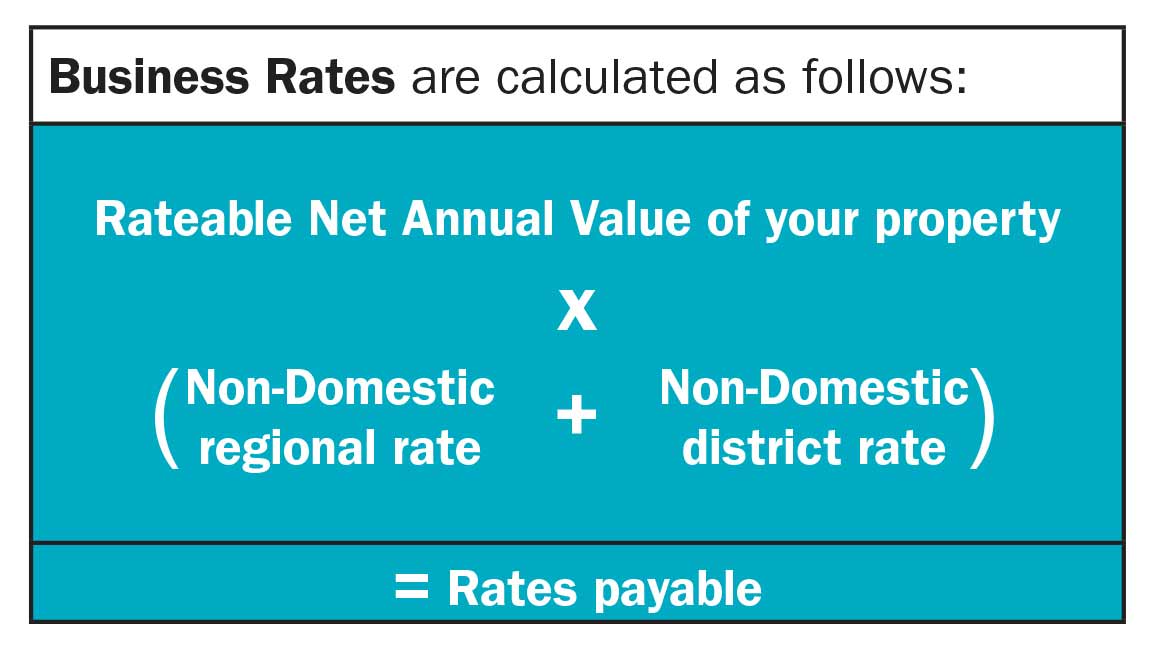
Regional and district rates
The regional rate is set annually by the Northern Ireland Executive and is applied to each district council area in Northern Ireland. The district rate is set annually by each district council in Northern Ireland.
Find the the 2026-27 non-domestic rate poundages for your council area.
Net Annual Value
Rates for non-domestic or business properties are assessed on their rental value, also known as the Net Annual Value (NAV). NAV is an assessment of the annual rental value that your property could reasonably be expected to be let for if it was on the open market. Each non-domestic property is valued in line with comparable properties in the vicinity.
The current valuation list for non-domestic properties began on 1 April 2023 and is based on rental values as at 1 October 2021.
Find a property valuation for your business premises.
View your estimated rate bill
You can view an estimate of a full annual rate bill for the current rating year by inputting the address information using the Land & Property Services (LPS) online valuation search.
Find a property valuation and view your estimated rate bill.
Further information
If you have a query regarding business rates or are unsure of your outstanding bill, contact LPS.
NI Reval2026
The short video below explains the latest revaluation process, known as NI Reval2026, which will create a new valuation list that will be used to calculate business rate bills from April 2026.
Developed withAlso on this siteContent category
Source URL
/content/how-business-rates-are-calculated
Links
Rates for retail units
How business rates are calculated for retail units and how this differs from other types of non-domestic properties.
When calculating business rates for retail units Land & Property Services (LPS) assess the Net Annual Value (NAV) by using zoning. Zoning is a methodology used in assessing the rental value of retail units and is used for shops, hair salons, banks, betting shops and most restaurants. LPS use zoning as it helps take into account different sizes and shapes of shops and awkward layouts.
LPS also consider other parts of the property that are ancillary or tertiary spaces such as upstairs offices and store rooms. They are rated but zoning is not applied for these areas of the property. Some spaces are not considered useable retail areas and are excluded from valuation. These spaces include toilets, lobbies, plant rooms and stairwells.
Further information
If you have a query regarding business rates, contact LPS.
NI Reval2026
On Thursday 29 January 2026, the Finance Minister John O'Dowd announced a pause of the Reval 2026 process. This page will be updated when the next steps are confirmed.
The short video below explains the latest revaluation process, known as NI Reval2026, which will create a new valuation list that will be used to calculate business rate bills from April 2026.
Developed withAlso on this siteContent category
Source URL
/content/rates-retail-units
Links
Rates for licensed premises
How business rates are calculated for licensed premises and how this differs from other types of non-domestic properties.
When calculating business rates for licensed premises, Land & Property Services (LPS) assess the Net Annual Value (NAV) by calculating the correct level of Fair Maintainable Trade (FMT). LPS does this by collecting information about rent, trading receipts, and trading patterns. LPS analyses this information along with the type of premises, the area it is in, and what services it offers.
As there is little evidence of rents for pubs, LPS uses FMT in the assessment to help assess a rateable value or NAV. This is the industry standard and is the approach used across the UK.
LPS applies a percentage to the estimated FMT to assess the annual rent. It is based on factors such as, where the premises are located, the sort of premises they are (bar, hotel, etc.), and the sort of trade carried on. LPS regularly consults with trade associations to ensure its approach continues to reflect how the licensed industry operates.
Further information
If you have a query regarding business rates, contact LPS.
NI Reval2026
On Thursday 29 January 2026, the Finance Minister John O'Dowd announced a pause of the Reval 2026 process. This page will be updated when the next steps are confirmed.
The short video below explains the latest revaluation process, known as NI Reval2026, which will create a new valuation list that will be used to calculate business rate bills from April 2026.
Developed withAlso on this siteContent category
Source URL
/content/rates-licensed-premises
Links
Business rates: Occupying, leaving or vacating a property
How your business rates are affected if you occupy, leave, or vacate a property and how to inform Land and Property Services of changes.
Moving into a new business property
When you move into your new property, you must contact Land & Property Services (LPS) Rating office to let them know, otherwise you may receive a backdated rate bill. You can also advise them of how you wish to pay your rate bill.
Moving into a newly built business property
If you are moving into newly built premises, you must contact the LPS Valuation office. A valuer will come out to assess your property. A rate bill will then be issued based on this valuation. You should be aware that failure to inform LPS could lead to the issue of a backdated rate bill.
You can apply online to have your new property valuation assessed, or you can apply for a new property valuation or review of property valuation.
This is a writable document, which means that you can complete it on screen and send it as an attachment by email to print and send to the LPS Valuation office. You can also print and post it to LPS using the address on the form.
Leaving your old business property
When you move out of your property, you must contact LPS. You should have your Account ID, Ratepayer ID, and details of the new owners or people in your property to hand.
Alternatively, you can use the online form to make changes to your rate account, such as personal information, billing address for your rate bill, notification of a ratepayer's death, or change the assessment period for your rate account.
You can also make changes to your rate account through your Rates Online account.
Further information
If you have a query regarding business rates, contact LPS.
Developed withAlso on this siteContent category
Source URL
/content/business-rates-occupying-leaving-or-vacating-property
Links
How Land & Property Services uses your information
How LPS uses customer data and how they protect this data under the legislation.
Land & Property Services (LPS) fully complies with the Data Protection Act 2018 and the Department of Finance's Data Protection Policy. This means that how LPS collects, stores, uses, and discloses/shares the information you provide to them meets the standards of this legislation.
Reasons why LPS collates and holds customer information
LPS holds customer information for:
- the purpose of billing
- collection and recovery of rate revenue
- assessment of benefit/relief claims
- the creation and maintenance of Valuation Lists
- the Land Registration Public Register
LPS and the National Fraud Initiative
LPS has a duty to protect public funds and may use the information provided for the prevention and detection of fraud.
LPS participates in the National Fraud Initiative, an exercise that matches electronic data within and between audited bodies to prevent and detect fraud.
The use of data by the Audit Commission does not require the consent of the individuals concerned under the Data Protection Act 2018. However, it is controlled to ensure compliance with data protection and human rights legislation.
For more information, contact LPS.
Developed withAlso on this siteContent category
Source URL
/content/how-land-property-services-uses-your-information
Links
Rates for retail units
Business rates and types of premises
Types of property that must pay business rates and those that are excluded.
Business or non-domestic premises include most commercial properties, such as shops, offices, pubs, warehouses, and factories.
Properties excluded from the valuation list for business rates
There are some types of properties that are specifically excluded from the valuation list and therefore not subject to rates:
- fish farms
- most farmland and farm buildings
- most cemeteries and crematoriums
- turbary and fishing rights
- moveable moorings
- public parks
- sewers
Properties exempt or partially exempt from business rates
Some non-domestic premises that are exempt or partially exempt from rates include:
- places of public religious worship and church halls
- district council swimming pools and recreation facilities
- charity shops selling only donated goods
- ATMs in designated rural wards
Mixed-use properties and business rates
If part of a building is used for business and part for residential purposes - such as a shop with a flat above or a solicitor's office in a domestic property - the part used for business counts as non-domestic premises. So, if you live and work on the same premises, you generally pay business rates on the part of the property used for business and domestic rates on the residential part.
Rental properties and business rates
Special rules apply to landlords, owners, and tenants depending on the level of Capital Value for domestic properties or Net Annual Value for non-domestic properties. Rental properties and business rates.
Working from home and business rates
If you use your home as a workplace, the part of the property used for work may be liable for business rates. You will still have to pay domestic rates on the rest of the property. Whether you are charged business rates or not depends on the degree of business use. You are more likely to have to pay business rates if a room is used exclusively for business or has been modified, eg, as a workshop. Each case is considered individually.
Further information
If you have a query regarding your business rates, contact Land & Property Services.
Developed withAlso on this siteContent category
Source URL
/content/business-rates-and-types-premises
Links
How business rates are calculated
How rates are calculated for business premises and how to get an idea of what your rate bill may be.
Your rate bill is made up of a number of parts including the regional rate, the district rate and Net Annual Value (NAV). Your rate bill is calculated by multiplying the NAV of your property by the non-domestic rate poundage (non-domestic regional rate + non-domestic district rate) for your council area for the relevant year (as shown below):
Regional and district rates
The regional rate is set annually by the Northern Ireland Executive and is applied to each district council area in Northern Ireland. The district rate is set annually by each district council in Northern Ireland.
Find the the 2026-27 non-domestic rate poundages for your council area.
Net Annual Value
Rates for non-domestic or business properties are assessed on their rental value, also known as the Net Annual Value (NAV). NAV is an assessment of the annual rental value that your property could reasonably be expected to be let for if it was on the open market. Each non-domestic property is valued in line with comparable properties in the vicinity.
The current valuation list for non-domestic properties began on 1 April 2023 and is based on rental values as at 1 October 2021.
Find a property valuation for your business premises.
View your estimated rate bill
You can view an estimate of a full annual rate bill for the current rating year by inputting the address information using the Land & Property Services (LPS) online valuation search.
Find a property valuation and view your estimated rate bill.
Further information
If you have a query regarding business rates or are unsure of your outstanding bill, contact LPS.
NI Reval2026
The short video below explains the latest revaluation process, known as NI Reval2026, which will create a new valuation list that will be used to calculate business rate bills from April 2026.
Developed withAlso on this siteContent category
Source URL
/content/how-business-rates-are-calculated
Links
Rates for retail units
How business rates are calculated for retail units and how this differs from other types of non-domestic properties.
When calculating business rates for retail units Land & Property Services (LPS) assess the Net Annual Value (NAV) by using zoning. Zoning is a methodology used in assessing the rental value of retail units and is used for shops, hair salons, banks, betting shops and most restaurants. LPS use zoning as it helps take into account different sizes and shapes of shops and awkward layouts.
LPS also consider other parts of the property that are ancillary or tertiary spaces such as upstairs offices and store rooms. They are rated but zoning is not applied for these areas of the property. Some spaces are not considered useable retail areas and are excluded from valuation. These spaces include toilets, lobbies, plant rooms and stairwells.
Further information
If you have a query regarding business rates, contact LPS.
NI Reval2026
On Thursday 29 January 2026, the Finance Minister John O'Dowd announced a pause of the Reval 2026 process. This page will be updated when the next steps are confirmed.
The short video below explains the latest revaluation process, known as NI Reval2026, which will create a new valuation list that will be used to calculate business rate bills from April 2026.
Developed withAlso on this siteContent category
Source URL
/content/rates-retail-units
Links
Rates for licensed premises
How business rates are calculated for licensed premises and how this differs from other types of non-domestic properties.
When calculating business rates for licensed premises, Land & Property Services (LPS) assess the Net Annual Value (NAV) by calculating the correct level of Fair Maintainable Trade (FMT). LPS does this by collecting information about rent, trading receipts, and trading patterns. LPS analyses this information along with the type of premises, the area it is in, and what services it offers.
As there is little evidence of rents for pubs, LPS uses FMT in the assessment to help assess a rateable value or NAV. This is the industry standard and is the approach used across the UK.
LPS applies a percentage to the estimated FMT to assess the annual rent. It is based on factors such as, where the premises are located, the sort of premises they are (bar, hotel, etc.), and the sort of trade carried on. LPS regularly consults with trade associations to ensure its approach continues to reflect how the licensed industry operates.
Further information
If you have a query regarding business rates, contact LPS.
NI Reval2026
On Thursday 29 January 2026, the Finance Minister John O'Dowd announced a pause of the Reval 2026 process. This page will be updated when the next steps are confirmed.
The short video below explains the latest revaluation process, known as NI Reval2026, which will create a new valuation list that will be used to calculate business rate bills from April 2026.
Developed withAlso on this siteContent category
Source URL
/content/rates-licensed-premises
Links
Business rates: Occupying, leaving or vacating a property
How your business rates are affected if you occupy, leave, or vacate a property and how to inform Land and Property Services of changes.
Moving into a new business property
When you move into your new property, you must contact Land & Property Services (LPS) Rating office to let them know, otherwise you may receive a backdated rate bill. You can also advise them of how you wish to pay your rate bill.
Moving into a newly built business property
If you are moving into newly built premises, you must contact the LPS Valuation office. A valuer will come out to assess your property. A rate bill will then be issued based on this valuation. You should be aware that failure to inform LPS could lead to the issue of a backdated rate bill.
You can apply online to have your new property valuation assessed, or you can apply for a new property valuation or review of property valuation.
This is a writable document, which means that you can complete it on screen and send it as an attachment by email to print and send to the LPS Valuation office. You can also print and post it to LPS using the address on the form.
Leaving your old business property
When you move out of your property, you must contact LPS. You should have your Account ID, Ratepayer ID, and details of the new owners or people in your property to hand.
Alternatively, you can use the online form to make changes to your rate account, such as personal information, billing address for your rate bill, notification of a ratepayer's death, or change the assessment period for your rate account.
You can also make changes to your rate account through your Rates Online account.
Further information
If you have a query regarding business rates, contact LPS.
Developed withAlso on this siteContent category
Source URL
/content/business-rates-occupying-leaving-or-vacating-property
Links
How Land & Property Services uses your information
How LPS uses customer data and how they protect this data under the legislation.
Land & Property Services (LPS) fully complies with the Data Protection Act 2018 and the Department of Finance's Data Protection Policy. This means that how LPS collects, stores, uses, and discloses/shares the information you provide to them meets the standards of this legislation.
Reasons why LPS collates and holds customer information
LPS holds customer information for:
- the purpose of billing
- collection and recovery of rate revenue
- assessment of benefit/relief claims
- the creation and maintenance of Valuation Lists
- the Land Registration Public Register
LPS and the National Fraud Initiative
LPS has a duty to protect public funds and may use the information provided for the prevention and detection of fraud.
LPS participates in the National Fraud Initiative, an exercise that matches electronic data within and between audited bodies to prevent and detect fraud.
The use of data by the Audit Commission does not require the consent of the individuals concerned under the Data Protection Act 2018. However, it is controlled to ensure compliance with data protection and human rights legislation.
For more information, contact LPS.
Developed withAlso on this siteContent category
Source URL
/content/how-land-property-services-uses-your-information
Links
Six tips for choosing the right business property
In this guide:
- Choosing the right commercial property
- Business property specification
- Choose the right location for your business premises
- Legal considerations when choosing business property
- Deciding on the right premises for your business (video)
- Search for commercial property
- Six tips for choosing the right business property
- Choosing the right premises to suit our business needs - Totalmobile (video)
Business property specification
How to draw up a wish list that sets out what you want when searching for suitable commercial premises.
Preparing a clear business property specification is an important first step when choosing commercial property. A well-defined property spec helps you focus your search for commercial premises, compare options consistently, and avoid wasting time on unsuitable business property.
What is a property specification?
A business property specification, or property spec, is a written list of what you need from your commercial premises for business. It sets out your essential and desirable requirements. It guides your search for business premises to rent or buy, whether you are looking at larger sites or commercial properties for a small business.
Key points to include in your property spec
Your property spec might detail how the following requirements should be met when looking for suitable commercial real estate or business premises.
Property size and layout
Decide how much space you need now and, in the future, based on staff numbers, equipment and storage. Consider whether an open-plan layout, individual offices, or a mix of both will work best, and whether you need extra areas for equipment, storage, meetings, breakout spaces or socialising.
Property appearance
Think about how the business property looks both inside and out. If clients or customers will visit regularly, you may need a more visually attractive exterior and a professional, welcoming interior that reflects your brand and creates a good first impression.
Property structure
Identify any special structural requirements. For example, you may need high ceilings, upper-floor loading capacity, reinforced floors or foundations, or specific loading doors or access arrangements to support your operations.
Premises facilities
Consider the comfort and wellbeing of employees and visitors. Make a note of the standard of lighting, toilet and washrooms, reception or waiting areas, kitchen or tea points, and any staff welfare or breakout facilities you require.
Property utilities and connectivity
List the utilities and services you need for your commercial property to operate efficiently. This can include:
- adequate power supply and type (for example, three-phase electricity)
- heating and cooling systems to maintain comfortable working conditions
- sufficient power points for computers and equipment
- suitable water supply and drainage
- broadband speed and reliability, including fibre availability
Older buildings may need rewiring, upgraded heating or air conditioning, or additional toilet and kitchen facilities, so factor potential upgrade costs into your planning.
Planning permission and use
Check whether you may need planning permission or a change of use to run your type of business from the premises. Understanding this early can help you avoid delays or unexpected costs once you have chosen your commercial premises.
Access and parking
Think about how people and goods will reach your business property. Consider:
- proximity to main roads and public transport
- ease of access for deliveries and collections
- accessibility for customers, including disabled customers
- on-site or nearby car parking for staff, customers and visitors
- any need for cycle parking or other sustainable transport options
Option to extend or make alterations
Assess how flexible the commercial real estate is if your requirements change. Look at whether you can make internal alterations, install partitions, expand into neighbouring space, or extend the building in future, subject to any necessary consents.
Long-term business plans
Review your business plan and consider how the business premises you choose will support your long-term direction. Think about potential growth, new services or products, changes in staffing levels, or future technology needs, and whether the property can adapt to these.
Property location
Location is a crucial factor when choosing commercial property. You need to think about where your property should be to suit your customers, workforce and suppliers, as well as your brand image and operational needs. For detailed location factors you should consider, see choose the right location for your business premises. See, choose the right location for your business premises.
Property costs
Your choice of commercial property will also depend on your budget. Whether you rent or buy business premises, likely costs can include:
- initial purchase costs (if buying property), including legal costs and surveyor's fees
- initial alterations, fitting out and decoration
- any alterations required to meet building, health, safety and fire regulations
- ongoing rent (if leasing premises), service and utility charges, including water, electricity and gas
- business rates
- continuing maintenance and repairs
- building and contents insurance
It can be useful to compare the costs of buying business property with the costs of buying business property so you can decide which option is more suitable for your cash flow and growth plans.
Energy performance of the property
Energy efficiency affects both your running costs and environmental impact. Sellers and landlords must provide prospective buyers or tenants with an Energy Performance Certificate (EPC). An EPC shows how energy efficient a building and its services are and provides a good indication of likely energy costs. You may wish to prioritise commercial property for small businesses that offer better energy performance to help control long-term overheads. See Energy Performance Certificates for business properties.
Prioritising your requirements
If your property requirements are too specific, your choice of commercial premises for business may become very limited or too expensive. Divide your property spec into:
- essential requirements that you cannot compromise on
- desirable features that are beneficial but negotiable
This helps you stay flexible and make a balanced decision when comparing different commercial property options.
Considering working from home
Once you have drawn up your list of property requirements, you may decide that working from home suits your needs better, either full-time or as part of a hybrid model. If so, remember that there are important legal, tax and practical issues to consider, including planning, insurance and health and safety. See use your home as a workplace.
Also on this siteMore Case StudiesContent category
Source URL
/content/business-property-specification
Links
Choose the right location for your business premises
How to identify the advantages and disadvantages when choosing a suitable location for your commercial property.
Choosing the right location for your commercial property is a vital decision for any business. Your business premises should be convenient for customers, employees and suppliers, while still being affordable and aligned with your long term plans. When choosing commercial property, you should weigh up the advantages and disadvantages of different locations before committing to any business property.
What location factors should I consider when looking for business property?
To judge the best location for your commercial premises for business, consider the key factors below and how important each one is to your business priorities. These points apply whether you are looking for business premises to rent, business premises to buy, or specific commercial property for a small business.
Footfall
For many businesses – especially in the retail, hospitality or personal services sectors – the level of passing trade can have a major impact on sales and visibility. Busy high streets, shopping centres, or transport hubs can provide higher footfall but usually come with higher commercial real estate costs and business rates.
Competitors in the area
The number and type of competitors nearby can significantly affect your performance. Some businesses, such as estate agents or restaurants, can benefit from clustering together, as customers often compare options in one area. For many other firms, too many direct competitors close by can reduce your market share and profitability, so it is worth surveying the local area carefully before choosing your business property.
Transport links and parking
Good public transport links and local parking facilities make it easier for employees, customers and suppliers to reach your commercial property. Check proximity to bus routes, train stations, cycle paths and major roads, and consider whether there is sufficient, affordable parking nearby for staff and visitors.
Delivery restrictions
If your business relies on regular deliveries or collections, it is important that your commercial premises for business are easy for vehicles to access. Investigate any delivery time restrictions, loading bay rules, or weight limits that could affect your suppliers or logistics operations.
Planning restrictions
Before you commit to a location, make sure the premises can legally be used for your type of business. Check planning permission and local zoning or use classes to ensure your activity is permitted, and identify any restrictions that might limit how you operate or expand in future.
Business rates
Business rates can be a major ongoing cost and vary depending on property value and location. High-profile city or town centre locations can attract higher rates, which may reduce the attractiveness of otherwise ideal business premises to rent or buy. It is important to get an indication of what you may have to pay so you can factor it into your overall budget. See estimate your rate bill.
Local amenities
Local amenities can make a location more attractive for both employees and customers. Staff often prefer working in areas with nearby shops, cafés, childcare, gyms and other services. You may also need convenient access to banking facilities, postal depots and professional services to support day-to-day operations in your commercial property.
Type and image of an area
The nature and reputation of the area can affect how your business is perceived. A location associated with high crime or anti-social behaviour may deter customers and staff, while a well-regarded business district or regeneration area can enhance your image. Think about how the area aligns with your brand and the clients you want to attract when choosing commercial property.
Deciding on your property location
Every location will have both advantages and disadvantages, so finding the right business property is often a balancing act. For example, an office in a rural setting may be quieter and cheaper, but harder for staff, customers or suppliers to access. A prime city centre site may be excellent for visibility and transport links, but more expensive in terms of property costs, business rates and parking.
Location has a major impact on your overall business costs and on the value you get from your commercial real estate. If you need premises in a prime area – for example, to access key clients or benefit from strong footfall – the extra cost may be justified. The key is to prioritise the factors that matter most to your strategy and choose commercial property that offers the best overall fit for your business.
Also on this siteMore Case StudiesContent category
Source URL
/content/choose-right-location-your-business-premises
Links
Legal considerations when choosing business property
What legal obligations and restrictions to consider when choosing commercial premises.
When choosing commercial property, it is essential to understand the legal obligations and restrictions that apply to your business property. These rules affect both owners and occupiers and will influence the suitability of any commercial premises for business, whether you are looking for business premises to rent or business premises to buy.
Planning permission and permitted use
Your commercial property must have the correct planning permission or use class for your type of business. If you intend to change how the property is used, extend it, or alter its layout, you may need to apply for new planning consent or building control approval.
Failing to comply with planning requirements can lead to enforcement action, so always check permitted use before committing to any commercial property for a small business or larger operation.
Building, fire and health and safety compliance
All commercial property must meet relevant building regulations and fire safety standards. You will need to carry out suitable fire risk assessments, maintain fire detection and alarm systems where required, and ensure that escape routes, emergency lighting and fire-fighting equipment are appropriate for your business premises.
You must also comply with health and safety law to protect employees, contractors and visitors, including providing safe access, adequate ventilation, lighting, welfare facilities and a generally safe working environment. See fire safety and risk assessment.
Business rates, stamp duty and other charges
Most business premises to rent or buy will attract business rates, based on the property’s rateable value and local rules. In many cases, stamp duty land tax (or the relevant property tax) is payable on commercial property purchases and some leases, so factor this into your budget alongside rent or mortgage payments.
Clarify in advance whether the landlord or tenant is responsible for business rates, service charges and other recurring costs before you sign any agreement for commercial premises for business.
Landlord, tenant and lease obligations
If you occupy business premises to rent, the terms of your lease or licence will set out your rights and responsibilities. These may cover rent reviews, repairing obligations, service charges, use restrictions, alterations, subletting, break clauses and how and when the lease can be ended.
You should ensure that any lease for commercial real estate is clearly understood and, where possible, professionally reviewed so you know exactly what you are committing to over the term. See commercial property: landlord and tenant responsibilities.
Employer duties and workplace conditions
If you employ staff in your commercial property, you are responsible for their health, safety and welfare while at work. This includes providing suitable welfare facilities (such as toilets, washing facilities, drinking water and rest areas), a healthy indoor environment and safe systems of work.
You must identify and manage workplace risks, maintain equipment safely and ensure your business property is suitable for the number of people working there. See workplace welfare facilities and healthy working environment.
Accessibility and equality requirements
If you provide goods or services to the public, you must take reasonable steps to make your commercial premises for business accessible to disabled people. This may involve ramps or step-free access, appropriate signage, accessible toilets, suitable door widths or layout changes.
Considering accessibility early, when choosing commercial property, can save costs and reduce the risk of failing to meet equality and anti-discrimination duties. See disabled access and facilities in business premises.
Operating licences, restrictions and environmental controls
Certain types of business activity require licences or permits – for example, selling alcohol, handling specific waste types or operating some regulated services. There may also be conditions on when deliveries can take place, limits on noise levels, restrictions on emissions, and rules on waste storage and disposal. Before you choose business premises to buy or rent, check whether your activities will need additional permissions or be affected by local environmental or neighbourhood restrictions.
Insurance for business property and assets
Whatever commercial property you occupy, adequate insurance is essential. Common policies include buildings insurance (if you are responsible for the structure), contents and equipment insurance, public liability, employer’s liability and business interruption cover.
Check what the landlord insures, what you must insure yourself, and whether your chosen commercial property for a small business presents any special risks that need extra cover. See insurance: business property and assets.
Getting professional legal advice
Legal requirements around commercial real estate can be complex and may vary depending on location, sector and property type. Before signing a lease, purchase contract or licence, it is sensible to seek advice from a suitably qualified solicitor or business adviser experienced in commercial property. They can help you interpret legal documents, identify hidden risks and ensure the business property you choose is compliant and suitable for your plans. Choose a solicitor for your business.
More Case StudiesContent category
Source URL
/content/legal-considerations-when-choosing-business-property
Links
Deciding on the right premises for your business (video)
Short video outlines key factors to consider when deciding on suitable business premises.
View this short video (2 minutes 30 seconds) below that outlines important factors to consider when deciding on the right business premises. It explores issues such as cost, location, facilities, and infrastructure.
Also on this siteContent category
Source URL
/content/deciding-right-premises-your-business-video
Links
Search for commercial property
Specifying what you want when searching for business premises and where you can search for suitable commercial property.
Starting your search for commercial property by drawing up a clear business property specification is one of the most effective ways to find suitable commercial premises for business. A well-defined “property spec” sets out your essential and desirable requirements, helps you prioritise location and property features, and makes it easier to compare different business premises to rent or business premises to buy.
Define what you need before you search for a property
Begin by creating a written specification that clearly describes what you need from your business property. Include details such as size, layout, facilities, utilities, accessibility, budget range, and preferred locations, and highlight which points are non-negotiable and which are flexible. This will guide your decisions when choosing commercial property and reduce the time spent viewing unsuitable options.
Where to search for commercial property
There are several ways to search for commercial property for small businesses and larger organisations in Northern Ireland and across the UK:
- Use dedicated tools such as our commercial property finder, which provides access to a wide range of office, industrial, and other commercial listings across Northern Ireland.
- Search specialist commercial and mixed-use listings on local portals such as PropertyPal and national platforms like Rightmove and other major commercial property websites.
- Visit individual estate agents’ and commercial surveyors’ websites, where many agents advertise local commercial property to rent or for sale.
As you find options, check each potential property against your specification and remove any that do not meet all of your essential criteria. You can then create a shortlist of business properties to visit in person, focusing only on those that match your priority needs.
Professional advice during your property search
At the viewing and negotiation stage, it is often helpful to seek professional advice. A qualified surveyor can assess the condition of a property, highlight any structural or maintenance issues, and give you an informed view on value and suitability for your intended use. See buying commercial property: using a surveyor.
When you are ready to make an offer or agree on lease terms, a solicitor experienced in commercial real estate can help negotiate the deal and handle the legal work involved in renting or buying business premises. See buying commercial property: using a solicitor.
Taking these steps will help you conduct a focused, efficient search for commercial premises, making it easier to secure the right property in the right location for your business.
Also on this siteMore Case StudiesContent category
Source URL
/content/search-commercial-property
Links
Six tips for choosing the right business property
Six tips to help you find a suitable commercial property to buy or rent for your business.
Choosing commercial property is easier when you follow a clear, step-by-step process that keeps your business needs, budget, and long-term plans in focus. These six tips will help you narrow down suitable commercial premises for business, whether you are looking for business premises to rent or business premises to buy.
Top tips to help you find suitable commercial premises
1. Draw up a clear business property specification
Start by listing what you need from your business property before you begin viewing sites. Consider property size, layout, location, facilities, structural requirements, utilities, access, and parking, as well as your long-term business plans. Prioritise your requirements from must-haves to nice-to-haves so you can quickly rule out commercial properties that do not meet your essential needs.
See business property specification.
2. Don't underestimate the importance of location
Location can make or break the success of your commercial real estate. When choosing commercial property, think about customer footfall, where your competitors are based, local demographics, delivery and parking restrictions, transport links, and overall safety and image of the area. The right location for your commercial property for a small business might be a busy high street, a growing business park, or a well connected out of town site, depending on how your customers find and use your services.
See choosing the right location for your business premises.
3. Decide whether to buy or rent a commercial property
You will need to determine if buying or renting commercial property is best for your stage of growth and cash flow. Compare the flexibility of business premises to rent (typically lower upfront costs and easier to move) with the control and potential long term value of business premises to buy. Consider how long you expect to stay, how quickly your space needs might change, and whether tying up capital in commercial real estate is right for your overall business strategy.
See the advantages of renting commercial property versus the advantages and disadvantages of buying business property.
4. Calculate business rates and ongoing property costs
Before agreeing to rent or buy, estimate what you are likely to pay in business rates and other recurring charges for a particular commercial property. Factor in rent or loan repayments, service charges, utilities, insurance, maintenance, repairs, and any local taxes so you have a realistic total occupancy cost. Check whether you may qualify for any business rates reliefs or local support schemes that could make a specific commercial premises for business more affordable.
See help available for business rates.
5. Check the legal considerations for commercial property
Every business property is subject to legal requirements, so build these into your decision. Make sure the premises have the correct planning permission or use class, and that you can comply with building regulations, health and safety, fire safety, accessibility rules and any licensing requirements. If you are renting, review lease terms carefully – including break clauses, repairing obligations and use restrictions – and take advice from a solicitor experienced in commercial real estate before you sign.
See legal considerations when choosing business property.
6. Search widely and compare options for commercial property
Use multiple channels to search for commercial property, including local commercial agents, specialist online portals and regional property finders. Check each potential property against your specification, discard any that fail to meet your essential criteria, and then draw up a shortlist of business properties to view in person. Visiting several suitable sites will help you compare location, condition and value, and choose the commercial property that offers the best overall fit for your business needs.
Also on this siteMore Case StudiesContent category
Source URL
/content/six-tips-choosing-right-business-property
Links
Choosing the right commercial property
Choosing the right premises to suit our business needs - Totalmobile (video)
Video case study explaining how Totalmobile found the right premises to suit the needs of their growing business.
Malcolm Thompson, Chief Operating Officer of software provider Totalmobile, explains how they chose new premises to suit the needs of their growing business.
As Totalmobile expanded and its requirements changed, the business decided to move from its premises in the Antrim Technology Park to new rented premises in Belfast. The business had to consider various factors in order to make the right choice.
Here, Malcolm and Chief Executive Colin Reid discuss how the business identified the right premises and overcame the challenges of the move.
Case StudyMalcolm ThompsonContent category
Source URL
/content/choosing-right-premises-suit-our-business-needs-totalmobile-video
Links
Cyber insurance
In this guide:
Commercial property insurance
Types of property insurance available to business owners, including all risk and standard contracts.
If you have business property, taking out a suitable insurance policy will ensure you are covered for damage from a variety of causes. While you should check the policy details carefully, most standard insurance contracts will cover your buildings and premises for a range of risks including:
- fire and lightning
- explosion
- riot
- malicious damage
- storms
- floods
- damage caused by vehicles
Responsibility for insuring business property
If you are a tenant, ask your landlord who is responsible for insuring the premises. Normally the responsibility is with the landlord. The tenant, however, is usually responsible for shop fronts. See commercial property: landlord and tenant responsibilities.
If you are responsible for insuring the property, you could opt for 'all risk' insurance. These insurance policies do not name the risks covered, instead, they list any risks excluded - so all unnamed risks are automatically included. Property insurance policies do not cover:
- wear and tear
- electrical or mechanical breakdown
- any gradual deterioration specified in the policy
You should tell your insurer if your business property is left unoccupied for any length of time. Insurance cover is likely to be reduced to fire only and may not include malicious damage caused by vandalism.
Reinstatement value
You need to insure your business property for the full rebuilding cost, known as reinstatement, rather than just the market value. This is because you will only be able to claim the cost of what you have insured - regardless of the amount of damage.
A chartered surveyor will be able to help you to calculate the reinstatement value.
As well as insuring the building itself, you should also consider taking out public liability insurance if members of the public visit your premises.
Seeking advice on business insurance
To decide on the appropriate level of cover, you should seek professional advice from a regulated insurance company or broker. Insurance brokers, advisers, and other insurance intermediaries are regulated by the Financial Conduct Authority (FCA).
If you choose to deal directly with an insurer, it's worthwhile checking that they are a member of the Association of British Insurers.
HelpAlso on this siteContent category
Source URL
/content/commercial-property-insurance
Links
Business contents insurance
Replacement as new, business interruption and indemnity contents insurance available to business owners.
Property insurance only covers the physical building, so you will also need separate insurance cover for stock, machinery, and contents. You have the choice of either replacement as new insurance or indemnity insurance.
Indemnity insurance
Many business owners choose indemnity cover, which deducts the cost of any wear and tear when settling an insurance claim. Contents are also covered against theft, providing there has been forcible and violent entry to, or exit from, the business premises. See protect your business against crime.
You can also choose a business interruption policy that insures against loss of profit and higher overheads resulting, for example, from damaged machinery.
Seeking advice on business insurance
To decide on the appropriate level of cover it's a good idea to seek professional advice from a regulated insurance company or broker. Insurance brokers, advisers, and other insurance intermediaries are regulated by the Financial Conduct Authority (FCA) and you should make sure that your adviser has FCA authorisation. Find insurance through the British Insurance Brokers' Association.
If you choose to deal directly with an insurer, it's worthwhile checking that they are a member of the Association of British Insurers (ABI).
HelpAlso on this siteContent category
Source URL
/content/business-contents-insurance
Links
Specialist insurance for businesses
Specialist types of commercial assets insurance that might be relevant for your business.
Depending on the type of business you run, it may be wise to take out specialist insurance for your business assets. There are many types of commercial insurance you may wish to consider:
Loss of cash insurance
Provides cover to an agreed limit for the loss of money, whether in transit or from business premises.
Goods in transit insurance
Covers goods against damage while being moved. See insuring goods in transit.
Travel insurance
Essential if you or your employees travel abroad. Ensure that you are covered for working abroad as well as travelling, if necessary. See insure your business - people, life and health.
Commercial legal insurance
Covers legal expenses that may arise out of a change in legislation or penalties resulting from non-compliance.
Credit insurance
Insures you against debtors who are unable to pay you as a result of bankruptcy. See factoring and invoice discounting.
Engineering insurance
Provides specialist cover for machinery, including computers. By law, some types of machinery must be inspected regularly. An insurer will be able to tell you if this applies to your business and will often arrange inspection visits. To insure off-site machinery, you will need to purchase all risks cover.
Glass insurance
Covers the replacement of glass following malicious or accidental damage.
Professional indemnity insurance
Covers you against compensation claims if you have been negligent, resulting in damage or loss to a client.
Data processing insurance
Provides cover for electronic media and electronic data processing equipment.
A fidelity guarantee
Insures against any loss of money or stock as a result of staff dishonesty, such as theft.
Tradesman's tools can often be added to a liability package. See liability insurance.
Find insurance for your business. If you choose to deal directly with an insurer, it's worthwhile checking that they are a member of the Association of British Insurers (ABI).
HelpAlso on this siteContent category
Source URL
/content/specialist-insurance-businesses
Links
Commercial vehicle insurance
Type of motor insurance you will require for business vehicles or if employees use their own vehicle for business purposes.
By law any vehicle used on the road or other public place must be covered by a motor insurance policy. See motor insurance explained.
Vehicle insurance for business
If you, your employees, or anyone else working for your business uses a vehicle for work then you should check that:
- all vehicles owned by your business, such as cars, vans, or lorries, are covered by appropriate insurance
- any employees' vehicles used for or in connection with business have their insurance extended to cover use for their employer's business
- any personal vehicle insurance that you may have also covers business use
You should also make sure that the insurance cover provided by the policy is appropriate as there are different classes of business use. For example, travelling sales people or commercial representatives are considered differently from those making only occasional business trips, or who carry your products or other business assets.
See commercial motor insurance.
Business fleet insurance cover
If you own several vehicles you may be able to get business fleet cover that might offer better terms. Your insurance broker will be able to advise you on this. Find an insurance broker.
You need to check the licences of all your drivers and advise your insurers of any motoring convictions. Otherwise, you will not be properly insured. You will also need to tell insurers of any motoring convictions that happen after any insurance policy is in place. See fleet management.
If you choose to deal directly with an insurer, it's worthwhile checking that they are a member of the Association of British Insurers (ABI).
HelpActionsAlso on this siteContent category
Source URL
/content/commercial-vehicle-insurance
Links
Working from home: business insurance
Specialised insurance for homeworkers is essential as general household insurance will not cover your business.
If you work from home, you may need a specialist insurance policy. Household insurance will not cover any loss of office equipment, nor will it provide public liability cover.
Your standard household insurance may even be invalid if you work from home, although most household insurance policies can be extended to cover this. Similarly, you should check the terms and conditions of your mortgage, as lenders often need to be informed if you use your home to run a business.
Consult your insurance broker about which insurance policy would best suit your business needs and which will evolve with your business as it develops. Find an insurance broker. If you choose to deal directly with an insurer, it's worthwhile checking that they are a member of the Association of British Insurers (ABI).
HelpAlso on this siteContent category
Source URL
/content/working-home-business-insurance
Links
Cyber insurance
Cyber liability insurance helps you recover data losses, damage to IT systems, and costs if your business is the victim of cyber crime.
The vast majority of businesses will rely on IT systems to store and process valuable operational data and customer information. IT systems are vulnerable to cyber security risks such as scams, fraud, information theft, and malware or virus attacks.
A business is responsible for its own cyber security but in the event of a cyber attack, the right insurance policy that covers cyber liabilities may help your business recover. See cyber security for business.
What is cyber insurance?
Cyber insurance or cyber liability insurance is a type of insurance cover that aims to protect your business from IT threats and covers you if your systems or data has been lost, damaged or stolen in the event of a cyber attack.
See cyber risk insurance.
What does cyber insurance cover?
Most cyber insurance policies generally cover first-party and third-party costs relating to a cyber-attack.
First-party cyber insurance
First-party cyber insurance covers damage to your business such as the cost of investigating the cyber crime, restoring IT systems, recovering lost data, reputational damage, extortion payments demanded by cyber criminals and costs relating to business shutdown.
Third-party cyber insurance
Third-party cyber insurance covers the assets of others, typically your customers and any potential claims against you including damages and settlements as well as legal costs to defend your business.
Does my business need cyber insurance?
If your business uses, sends, or stores electronic data you could be vulnerable to cyber crime. Cyber insurance could help you with financial and reputational costs if your business is ever the victim of a cyber attack.
Also on this siteContent category
Source URL
/content/cyber-insurance
Links
Get the right insurance cover for your business
How to choose an appropriate insurance policy for your business, minimise costs and use insurance brokers.
There are many different types of insurance cover your business may require depending on what it does, how it operates, and where it does business. Each type of business insurance is designed to cover a different set of risks that you face in the course of running your business including:
- liability insurance
- commercial property insurance
- business contents insurance
- commercial vehicle insurance
- cyber insurance
- working from home: business insurance
- specialist insurance for businesses
See also business insurance: the basics.
Using an insurance broker
Few business owners deal directly with insurers. Most prefer to go through an insurance broker for impartial insurance advice. Insurance brokers can advise you on whether a single insurance policy or a combination of single insurance policies would be more appropriate. Be sure to give all relevant information to the insurer, otherwise, an insurance policy may not be valid.
Insurance brokers, advisers and other insurance intermediaries are regulated by the Financial Conduct Authority (FCA) and you should make sure that your adviser has FCA authorisation. Read the FCA guide to SME insurance brokers.
If you buy products or services from insurance intermediaries, you have the right to ask the intermediary how much commission they get for selling the product or service to you.
Dealing directly with an insurer
If you do choose to deal directly with an insurer, it's worthwhile checking that they are a member of the Association of British Insurers (ABI).
Some key points to consider when buying insurance are:
- quotes - get quotes from several different insurers or ask your broker to do so
- comparisons - compare the levels of cover in various insurance policies to make sure you get the right level of cover that your business requires
- tailored insurance - talk to your broker about whether you need an insurance policy tailored to your specific needs
What to consider when buying insurance
Other factors to take into account when choosing an insurance policy are:
- what the insurance policy will cover
- service
- cost
- whether there is a no-claims bonus
- whether the insurer offers 24-hour legal advice and emergency helplines
- the level of excess - the amount of each claim that you will have to pay yourself
- the extent of excess to be retained by your business
HelpAlso on this siteContent category
Source URL
/content/get-right-insurance-cover-your-business
Links
Making an insurance claim
Prompt contact with your insurer makes the process of making a claim for damage or loss of assets easier.
As soon as you discover a loss or damage to your business assets, you need to report it to your insurance provider. If you think that the loss or damage is due to a criminal act, you should report it to the police immediately. You should write down as many details as possible about what happened and when.
Information you need to provide to insurers
You will also need to provide your insurers with:
- estimates for repairs
- proof of the cost of any emergency repairs that were required, eg to make equipment or premises secure
- proof of ownership
- the cost of the items you are claiming for, with valuations and/or receipts
- a police crime reference number, if you think that your business has been the victim of a crime
- the opportunity to inspect any damaged assets if required
If you need to make emergency repairs, do so and advise your insurers of what you have done. If possible, advise insurers before going ahead, but it is most important that you prevent further damage that might increase the claim.
Loss adjuster
For large or complicated claims, the insurance company will often employ a loss adjuster. They will inspect the damage and check insurance claims for quantity, description, and pricing. Loss adjusters are impartial experts who can advise both the insurer and the policyholder.
They can also advise you on:
- how to improve security and safety
- areas of cover you may have overlooked
- repair techniques and specialist companies that can carry out such work
Loss assessor
You could employ a loss assessor who will negotiate and settle the insurance claim on your behalf. However, since they will charge a fee, it is usually only worth considering if you are likely to make a substantial insurance claim.
HelpAlso on this siteContent category
Source URL
/content/making-insurance-claim
Links